The quarterly business review has not changed in twenty years, but the infrastructure underneath CS has. This piece breaks down what auto-built QBRs actually require, why most teams are not ready, and what customer memory looks like when it is treated as infrastructure rather than an afterthought.
The QBR Has Always Had a Dirty Secret
Every quarter, something predictable happens inside CS teams. Someone books the QBR. Someone sends the calendar invite. And then someone, usually a CSM with a full book of accounts and a short runway, starts piecing together the story of the last 90 days from six different tools.
Product analytics from one tab. Support tickets from another. CRM notes from a third. Email threads they half-remember from two months ago. Usage reports pulled down as CSVs, reformatted, cross-referenced. A health score that may or may not reflect what’s actually happening.
By the time the QBR deck is finished, three to four hours have passed. The meeting lasts forty-five minutes. Half of it is spent catching the executive up on context they should already have. The second half is a polite handshake. Renewal conversation deferred.
This is the dirty secret of the quarterly business review: the format survives not because it works, but because nobody has built anything better. The QBR is a symptom of broken infrastructure masquerading as a ritual.
That is changing. Not because AI is hype. Because customer memory, the accumulated record of what a customer has done, said, escalated, adopted, and skipped over months of interaction, is finally becoming something a system can hold and act on, rather than something a CSM has to reconstruct from scratch every 90 days.
What the QBR Was Supposed to Do
Before diagnosing what’s wrong, it’s worth remembering what the QBR was designed for in the first place. The quarterly business review exists to answer a set of questions that a customer and a CSM can’t easily answer in the flow of daily work: Are we on track? What has actually changed since we last talked? What should we focus on next quarter?
These are good questions. The problem is not the questions. The problem is that the data needed to answer them well is scattered, stale, or assembled manually in the forty-eight hours before the meeting.
When a CSM walks into a QBR, they should be able to speak to the full arc of the customer relationship. What they actually have, most of the time, is a slide deck they built from whatever they could find, weighted toward whatever was easy to pull.
Paul Staelin, former CCO at Vercel, described the prep challenge clearly on Across the Funnel Podcast:
“I’m gonna have to partner with the champion on the other side, ’cause the champion and I effectively are gonna present to the sponsor together. But gathering all the data, usage data, the timeline of what happened, summarizing that into something that makes sense for an executive — that’s where all the time goes.”
That time tax is real, and it compounds across every account in a CSM’s portfolio. At 50 accounts, a CSM doing four QBRs a quarter is spending somewhere between twelve and twenty hours just on preparation. That is not time spent thinking strategically. That is time spent reconstructing a record that the customer relationship has already written.
The Gap Between What Happened and What Gets Presented
QBR preparation suffers from a structural problem that nobody talks about directly: the data that matters most is the hardest to aggregate.
Usage metrics are usually easy to pull. Support ticket volume can be counted. Login frequency shows up in dashboards. These are the numbers that end up in QBR decks because they are available, not necessarily because they are most meaningful.
What rarely makes it into the QBR is the qualitative record. The support ticket where the customer expressed frustration at a workflow they had been using for six months. The sales call note from eight months ago where the champion mentioned a business goal they cared about. The email thread where a key stakeholder asked a question that never got fully resolved. The CSM’s own call notes from a conversation three months back where the customer mentioned they were expanding their team.
This is the customer’s memory. It exists. It is recorded somewhere across multiple systems. But because it is fragmented, most of it never surfaces in a QBR at all.
Francesca Smedberg, former VP of Product at Rillion, spoke to this gap on Across the Funnel Podcast:
“Having those data, it was a very good ground for us to start leveraging AI to transform the data to over the customer. Having those customer insights and understanding your business where it is, is the only way to build actually an advantage towards customers.”
The insight here is worth sitting with. Internal data, the kind that CS teams generate constantly through calls, tickets, emails, and CRM notes, becomes strategically valuable when it is organized and made readable. Most teams have this data. Very few have a system that makes it accessible in time for a QBR.
What “Auto-Built From Customer Memory” Actually Means
The phrase “auto-built QBR” is easy to misread as a shortcut. It is not. What it describes is a fundamentally different architecture for how account intelligence is stored and retrieved.
In the current model, the QBR is built by a human who assembles context from disconnected sources. The quality of the QBR depends on how much time the CSM had, how well their memory serves them, and what tools happened to have accessible exports.
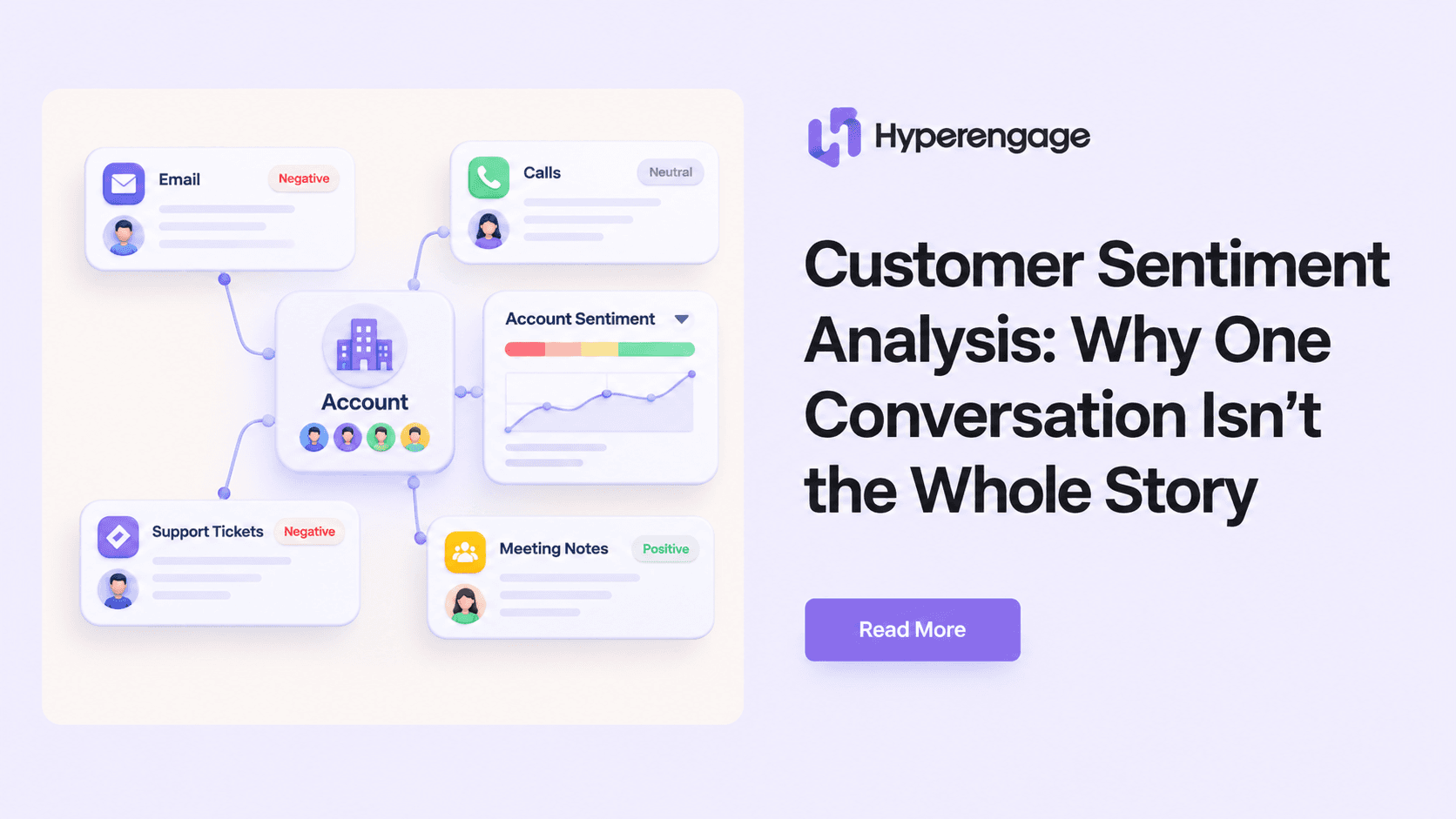
In the emerging model, the QBR is built from a living record of the account. Every product interaction, support exchange, email, call note, and CRM update is continuously indexed into a semantic model of the customer relationship. When it is time for a QBR, the system does not need to gather that data. It already has it, organized, weighted by recency and significance, ready to be surfaced.
The difference is not speed, though it is faster. The difference is completeness. A system that holds customer memory does not forget the escalation from four months ago. It does not miss the usage drop that happened in a module the CSM was not monitoring. It does not lose the strategic context that the previous CSM captured before they left the team.
This is what account intelligence platforms like Hyperengage are designed to enable: a semantic model of the account that accumulates over time, rather than being rebuilt from scratch before every review.
The Three Problems Auto-Built QBRs Actually Solve
Understanding why this matters requires being specific about what manually built QBRs get wrong, consistently.
The recency bias problem. When a CSM builds a QBR manually, recent events dominate the narrative. The incident from last month is vivid. The pattern that developed over six months is invisible. An auto-built QBR that draws from a continuous account record can surface trends that no single person would notice by themselves.
The handoff amnesia problem. When a CSM changes, the account memory typically resets. The new CSM starts from whatever is in the CRM, which is rarely the full picture. A system that maintains account memory across CSM transitions preserves institutional knowledge that would otherwise be lost in the handoff.
The selective visibility problem. CSMs naturally see what they touch. Support tickets they escalated. Emails they sent. But a customer’s experience extends beyond the CSM’s direct interactions. Product usage signals, billing events, emails to other team members, responses to automated outreach — all of this is part of the customer’s story. An auto-built QBR can draw from the full relationship record, not just the CSM’s corner of it.
What Has to Be True Before QBRs Can Build Themselves
Auto-built QBRs are not a feature you add to your current stack. They are the output of a specific infrastructure decision made earlier.
The precondition is a unified account record. That means product data, CRM data, support data, and communication data all flowing into the same semantic layer, connected by account identifier, indexed in a way that allows meaningful retrieval. Without that foundation, “auto-built” just means “AI summarized the same incomplete data you already had.”
This is the part of the conversation that most vendor pitches skip over. A QBR that summarizes only product usage is not a memory-built QBR. It is a usage report with a different format. True customer memory requires qualitative data: what customers said, what they asked, what they complained about, what goals they articulated. That data is almost always in email, call transcripts, support tickets, and CSM notes, and it is almost never properly indexed.
The practical implication is that CS teams who want to get to auto-built QBRs need to treat their qualitative data as infrastructure, not as a by-product. That means structured note-taking practices. Consistent call logging. Support tickets tagged in ways that make them searchable. CRM notes that capture intent, not just actions.
The teams doing this work now are the ones who will have account memory that a system can actually build from. The teams not doing it will still be manually assembling QBR decks in two years.
When the QBR Becomes Continuous
There is a version of this future where the quarterly business review is not really a quarterly format at all.
If account memory is continuously updated, the review can happen at any cadence that makes sense for the account. A high-risk account might warrant a monthly review. A stable, low-touch account might do well with a semi-annual one. An account that has just hit a significant milestone, a product adoption threshold, a seat expansion, a champion change, might warrant an unscheduled review triggered by the event itself.
The calendar-driven QBR was a practical necessity when data assembly was manual. You need 90 days to justify the prep time. If the prep time collapses to minutes because the account record is already assembled, the review frequency can match the account’s actual needs rather than the team’s administrative bandwidth.
This also changes what the QBR meeting itself is for. When the data is already organized and shared before the meeting, the conversation does not need to be spent on recap. It can start at the question that matters: given everything we know, what should we focus on next?
That is the version of the QBR that actually serves the customer relationship.
Conclusion
The QBR is not a broken format. It is a format that was designed for a world where data had to be gathered manually, and it reflects that world perfectly. The problem is that world is changing faster than the QBR has.
The teams who will get to auto-built reviews first are not the ones with the biggest budgets or the most sophisticated tooling. They are the ones who treat customer memory as something worth building deliberately: structured data, consistent logging, qualitative signals captured and indexed alongside the quantitative ones.
QBRs that build themselves from customer memory are not a projection. They are the logical output of infrastructure that CS teams can start building today. The question is not whether it is possible. It is whether the team is collecting the right data to make it work.