Episode No:168
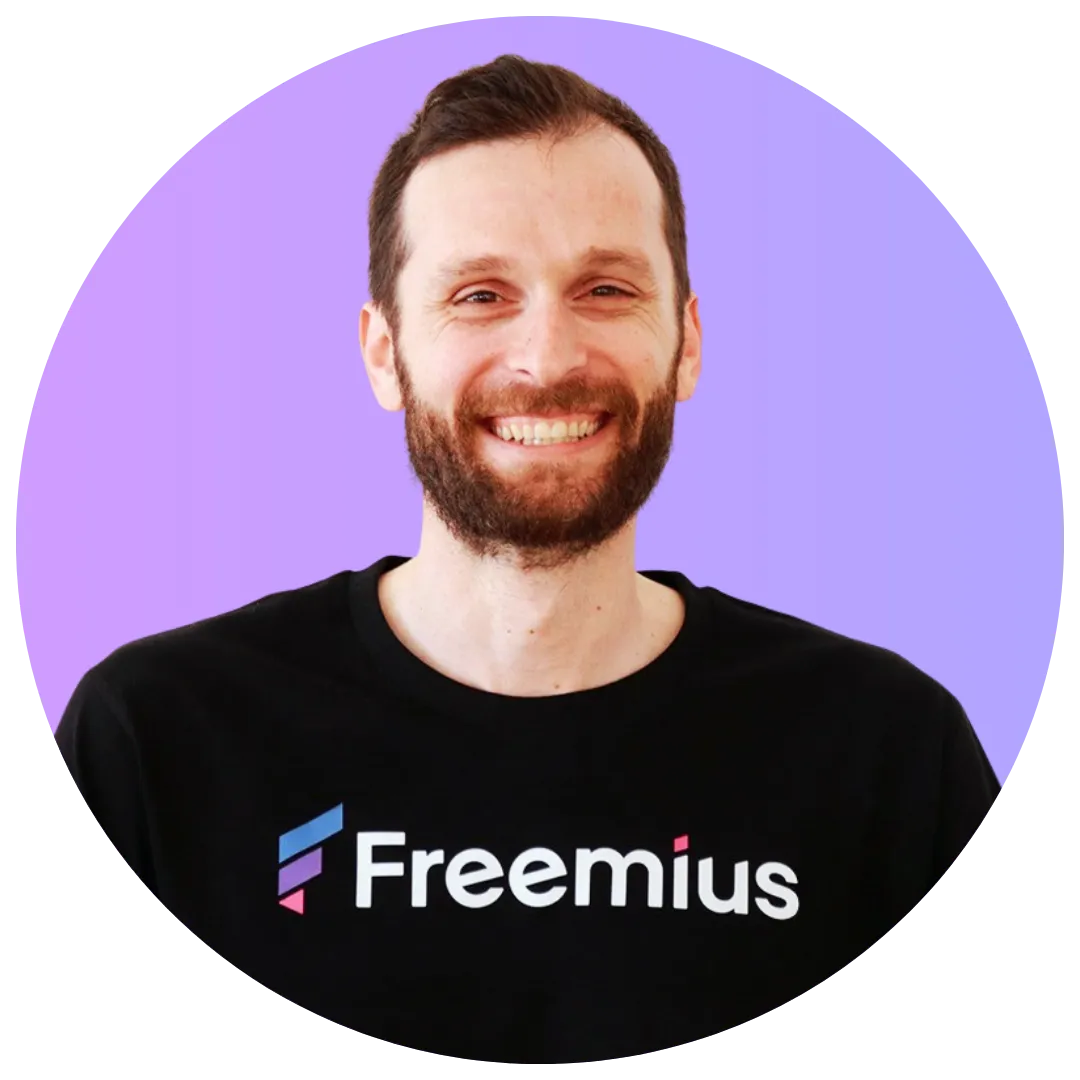
Ep # 168: Pricing and Packaging for AI Usage Plans: Credits, Metering, and What Actually Works ft. Vova Feldman (Founder, Freemius)
Vova Feldman
Founder, Freemius
Listen & Subscribe

Episode Summary
In this episode of Across The Funnel, Adil Saleh sits down with Vova Feldman, Founder at Freemius, to explore what it really takes to sell software globally when payments, subscriptions, invoicing, and tax compliance start competing with product work.
Vova shares Freemius’s origin story: building software was fast, but turning it into a business took a year of implementation work because monetization has too many moving parts, especially once global tax rules and subscription complexity enter the picture. They break down why “just use Stripe” often hides the full cost of cross-border fees, billing, taxes, and invoicing, and why founders should measure their payment stack like any other growth decision, with real unit economics, not assumptions.
The conversation also gets practical about GTM and retention: Freemius reduces churn by making value visible, shipping features tied to revenue lift and support reduction, and building a tight maker community that drives product ideas and creates buyer and investor connectivity. Looking ahead to 2026, they discuss how AI is pushing more products toward usage-based billing, and why pricing and packaging will become a core operator skill, including Freemius’s plans for pricing recommendation tools and pricing page feedback.
| Key Takeaways | Time |
|---|---|
| Time-To-Market Shrinks When Monetization Outsourced | 02:44 |
| Credibility-First Adoption For Revenue-Share Platforms | 06:15 |
| Treating Billing Stack As Non-Core Work | 11:32 |
| Merchant-Of-Record Education Reveals True Costs | 25:00 |
| Value Visibility Signals Lower Churn | 33:02 |
| AI Pushes Usage-Based Billing Normalization | 43:47 |
Transcript
Vova Feldman 00:02
Over the years, we improved the visibility of the value that we provide. So when we recover revenue or increase something, we notify the maker, the founder: hey, we saved you this amount of dollars. So once you start seeing those signals, it’s like, “Oh, it’s working for me.”
Intro 00:22
Welcome to Across the Funnel, where we dig into concrete Go-To-Market moves across sales, customer success, and account management, so you can build revenue that lasts. Brought to you by Hyperengage and Dextego.
Adil Saleh 00:36
Hey, greetings, everybody. This is the Hyperengage Podcast, and there’s a growing pain in the industry about how to manage. There are so many things on the revenue side of things for B2B SaaS, especially from seed to Series A in the first three years, pre-product-market fit, and a lot of this has been growing for quite some months now after this AI resource or bandwidth cutdown, technology shifting, and cost, a lot of undergoing costs in AI-powered or AI-native platforms into B2B SaaS.
Almost 90% of them say that we are AI-powered and AI-native. That is a different story. But we’re going to explore more today how you can manage the spend, how you can have one-in-all immersion for all of your subscription and all of your payment needs.
And we are talking to the co-founder of Freemius, Vova, today. Thank you very much, Vova, for taking the time.
Vova Feldman 01:33
Thanks for having me. I’m excited to be here. I love it.
Adil Saleh 01:37
So as we were talking back on the call, I know that backstage, it’s more of a problem today in an SMB, an early seed, than it is in the mid-market or, I would say, enterprises. Because early-stage companies, they want to go product-led sales, product-led growth, and that’s where they need a sort of one-size-fits-all for all of their payment needs, which has been the biggest problem for years. And there are a handful of tools, even if they are charging a lot more.
These startups or, I would say, companies in the SMB segment, there are quite a lot, like almost 500 million companies from 2000 to now, 2025. What is your mission at Freemius, first off, and how did you all start with this? I know that this comes a lot from: “Hey, I’ve been working on these previous shows, and I’ve kind of led this problem.” I’ve run previous startups and kind of led this problem, and now I want to solve it. So what was the kind of inception that you had in the beginning while building and thinking about building Freemius?
Vova Feldman 02:44
Yeah, so Freemius started around the end of 2014. It came from my personal kind of scratching my own itch. I had a side gig micro SaaS that I decided to monetize.
I joined with one more full-time guy and part-time, and we spent the year taking it from side hustle to a subscription-based freemium business. It worked well. We started to make money, draw salaries, but what was really kind of the aha moment is discovering that the product itself didn’t change, and it was something that I developed myself in two weekends of my spare time because I’m a developer, so I have that ability.
But on the other hand, to monetize or commercialize the solution, it took a year for two and a half people. So that disproportion kind of blew our minds, basically, because we realized that, especially today with AI, writing, creating software, it’s relatively easy, especially if you’re a professional developer. But when it comes to turning that into a business, it’s a completely different set of challenges.
It requires so many additional layers of understanding, of integrations with payment processors. You have global sales taxes, which became a huge headache because of all the changes that happened since 2014, since the European Union introduced the concept, basically charging customers based on the location of the customer, when previously it was based on the company. So that changed the entire kind of map of how you sell globally.
And when it comes to subscriptions, there are additional complexities, and so forth. The initial kind of goal of Freemius was to reduce the time to market for someone who has software and wants to sell it globally, from a matter of a year or a month to a matter of minutes. And then over time, it extended and became bigger, but that was kind of the origin story of Freemius.
Adil Saleh 04:57
Yeah, I mean, I know that you started long back and, of course, it took a minimum of a while. It’s good to have your expertise and your vision being translated at that moment. As you mentioned, to scale it, to do it, especially in this industry, it’s a very regulatory industry, and I know that it’s not easy. It’s as hard as any fintech, right?
So you’ve got to make sure that you have everything in place in terms of payments, regulation, security, all of that. So going through all of that while you were at it with a bunch of co-founders, what was the biggest challenge that you had in there? What was that like?
Maybe some connections, or maybe I know that you’re also a Techstars founder as well. Back in 2011, Senexx is a patent that acquired by Gartner, but you had a little bit of background. How did that help?
And what kind of challenges would you have for any founder listening and thinking about building in this vertical, going about regulations and funds might not be as big of a problem because building is fine, but scaling and getting the right sort of integrations with partners that are kind of mandatory, and security integrations and all of that. Could you walk us through that journey a little bit?
Vova Feldman 06:15
Yeah, I think first of all, I never did a startup that was easy. There are always some challenges in every industry. I started my early entrepreneurial journey.
I was into the B2C space and then we found explanations and excuses to ourselves why B2C is not the right way to go. Then we moved to enterprise, then we figured out: oh, there are so many other challenges in enterprise. How do you sell to enterprises, finding the champions in the right way and understanding all that ecosystem.
So I think unless you already tie down to a specific ecosystem and build a process machinery and did that specifically in that niche, I think every journey is different. For Freemius, there were many challenges and I would say mostly about credibility because for someone to use Freemius, they basically put in their entire revenue on the platform.
So when you start out and you still don’t have case studies, success stories, prove that this is working, this is reliable, and also there is a feature gap. You’re just starting out, you don’t have all the bells and whistles. So it takes a lot of time, gradually, to build that customer base, to create those reviews and success stories.
So it took us about a year to find the first person that will agree to opt in, and obviously they were an earlier and smaller maker on the platform. But once we got them, we already had some proof and we were able to bring others like them and maybe slightly higher. So it’s like gradually you bring bigger and bigger makers on the platform. So I would say those were the main kind of challenges.
Less about technology, of course you need money, right? If you are not making money in the beginning, but the model of the payments industry we’re at, it’s like revenue share. So once you start getting customers, there is some revenue coming in. It’s just by definition. This is the way it works.
We experimented with different pricing models and what we had in mind in the beginning didn’t work. So we had to iterate and actually about a month ago, we launched new pricing. So we reduced our pricing once again. Over the years, we basically reduced pricing all the time. We started with the highest and over time we reduced. The initial pricing didn’t make sense. We just didn’t have the right point of reference.
But the reason we recently relaunched our pricing is because the platform matured. It is not as time-consuming as it was before. We also expanded our offering and changed the architecture.
Previously, we were focused many years on a specific vertical, which was WordPress. So we provided a very in-depth solution for WordPress, which we still do, but it offers additional capabilities that are beyond the traditional merchant of record. So it requires more resources on our end, more costs, etc.
So now we’ve broken down the offering that you can get the more traditional kind of merchant of record if you are more price sensitive. And this is more compelling to SaaS and apps and others that don’t need the deep WordPress integration. And if you do want to use the full WordPress solution, you can still do that.
So there are a lot of iteration and we constantly trying to innovate, whether it’s in pricing, whether it’s in what we do in our offering. But yeah, I can keep going, but I feel that I’m going all over.
Adil Saleh 10:08
Yeah, I love that. Because, of course, you’re working with startups, you’re more like PLG and you fit more for product-led sales, product-led growth. Startups that are trying to find the best solution that covers all bases, as you mentioned. You know the startup problems more than me, right? Because you’re working closely with them and solving them.
So I would appreciate if you just go through a little bit, not so early-stage startups, but startups that are sitting between seed to Series A, like post-seed, pre-product-market fit, but post-seed that are close to, I would say 300 grand, 250, 300 grand a year with a handful of customers. And they are struggling to scale their payment and all of that section.
Because now, as my startup is pretty much in the same stage, so for banking, we use wires and everything, we use banks, like Brex and Mercury, I told you earlier. For subscription-based, because, of course, we have plans and subscription, like I have multiple businesses. So we have plans that we can for our SaaS product. We use Stripe for that and we have our business integrated with Stripe and that collects payment automatically.
So could you walk us through this, all of these problems being served at Freemius and maybe a couple of your case studies? You mentioned the industry vertical for a better understanding of me and the audience.
Vova Feldman 11:32
So you asked a bunch of questions. I will try to organize it in some direction.
I think, first of all, the size of the organization matters less. I think at the end of the day, the question, it’s about the resources that you have, the money that you have, and the cost, and the question of building versus buying. I think in the space of smaller organizations, it more depends on the type of the founder.
There are founders that are really into doing everything with their own hands. They want control. And for this type, I would say that this is a little premature approach because in the end, if you scale, you have to think bigger and it’s not necessarily about, “Oh, I need to control it.” You have to think about the numbers and whether it makes sense to control it versus buy something, and what’s kind of the long-term play.
But in the end, it’s a question of: as a founder, as a company, what you want to focus on is your core business. It’s not the revenue engine. The revenue engine is super important, of course, but it’s not your business.
And I’d like to give that example, right? There is a reason why we don’t go and build our own Google Analytics. That’s not the core business. It’s utility that I use. I also think that the revenue side of things, the subscription, there are solutions that this is their business, like Freemius. We’re experts in that. We have a big team that this is entirely what we do.
And it doesn’t matter how big your organization is. This is not the core focus of your business. So you will never be able to move as fast as we are on those angles. You will never prioritize that as we are because simply it’s not your business. It’s unrelated to your North Star metric of your organization. So that will never happen.
And in terms of what we are trying to cover as Freemius, we are trying to focus on the entire commercial stack, which means starting with the payments, the subscriptions, the invoicing. If it’s distributed software like desktop apps, everything that comes to software licensing and how it’s being connected with the subscriptions.
And we go higher and higher in that funnel, getting to things like the affiliate platform, which is naturally, you want to have one transactional, different marketing automation. Like if you look at modern e-commerce, there are constantly new mechanisms that are being added that can help you get the most out of the customer journey.
So if we look at the buyer journey, right, there is the discovery, then you get to the checkout, something happens. And in the end, eventually, someday you churn, but there are different touch points through the journey that you can increase conversion, increase the average sale price, do some expansion of the business, retention, reduce churn.
And we look at that entire journey and try to identify those touch points, those critical moments in the business, and be involved there and maximize the financial potential. This is how we’ll look at it.
And we also understand that as a product company, especially smaller businesses, but even larger, you don’t sit and think about all these emails and all these interactions again, because that’s not the key of your business. For us, this is what we do daily. We are exposed to all these cases all the time. So we constantly enrich the offering with those micro-interactions. But in the end, if you add all of that, that makes a big difference.
Adil Saleh 15:43
Love it. So, I mean, you’re pretty much sitting as an augmented layer across all of these operations, like payment or financial, economical events. You mentioned a little bit about customer interactions and integrates with all of those.
So what I call it, it’s all-in-one platform that helps as sort of an agent or what? Could you explain more?
Vova Feldman 16:10
Well, you can look at it as a business in a box, I would say, right? You come to the product, right? We make sure that you sell it, distribute it, and get the most financial potential out of it, right?
So technically, you can call it a merchant of record for selling software that is focused on marketing automation, conversion rate optimization, reducing churn, all those things. But in the end, it’s like business in a box.
An analogy that I like to give to people who are not from the industry is, let’s say you have a hobby and you’re really amazing at baking bread, right? You’re really good at it. And people will tell you, “Hey, why don’t you sell it to a friend? I want to buy it.”
But there is a mega gap between, “Oh, I’m really good at baking bread,” to, “Now I distribute it globally,” right? So this is what we do. We help you to take your bread, right? You focus on the baking of that bread, making it amazing, and we’ll ensure that we sell it all over the place while taking care of compliance and global sales taxes.
Adil Saleh 17:18
Is that going to be a productized service or is that going to be your team taking care of all of these?
Vova Feldman 17:25
Well, it’s all product. What I said, we do have some strategic advising baked into the platform because as part of our strategy, because it’s a revenue share model, our success directly relies on the success of our customers. So we want to ensure they’re successful.
So if we see opportunities in trying to do that in a proactive way to help them increase the revenue, we want to do that. We want to help them. So we are there to offer a strategic direction, strategic advice in key moments of their business in the same way how we look at the buyer journey.
We also look at the founder journey, right? From when you launch, when you grow, you scale, hopefully exit and not die. So most of our, because we’re focused on smaller industry, most of them, they don’t IPO. They either die or exit. Hopefully they exit.
So we’re trying to be in those strategic points when you go through different iterations of your business and help them with direction, how to price and package, how to launch. Okay, how do I start with marketing? How do I hire my first engineers? How do I scale my team in this? How do I do that? Why? Because we build that operation. We have our own experience. We have a lot of data. We’re seeing what’s working specifically in the software industry so we can bring those insights, including our firsthand experience, and be real with the people.
And also, we call our strategy team strategy, and this is very different than being a partner. Like we try to be real, not necessarily tell you what you want to hear just to keep you as a customer on our platform, but be real because we care about you. Because if we’ll tell you, kind of, you say something that we think is not a great idea and we kind of, “Yeah, yeah, you should do it,” just to have you in, but you won’t make any money, right?
It’s not good for you. It’s not good for us. So it’s like real collaboration, and as team members, we do want to be real with you. And when we need to push back, we’ll push back. But in the end, we see ourselves as this kind of extension of the makers that we’re working with. And we truly want you to succeed because we want to succeed.
Adil Saleh 19:48
That’s pretty interesting that you have a revenue share model that was, I was looking at the pricing and it was more like revenue based and you’re having this shared revenue success with your customers.
So now thinking about your customer segment, like I know you mentioned PLG, you mentioned SMB and SaaS, what other industry verticals are you expanding more on? I know 10 years down, it’s pure post product-market fit.
And as I hear you, this is quite amazing. The industry is pretty much going there. Like even SaaS, like one CRM is trying to be an agent for customer support. They’re trying to serve adjacent cases and trying to be an all-in-one solution. So that’s going to be going multi-product.
So what kind of other industry verticals are you thinking that would have a desperate need of these kind of solutions? And could you share more of your vision around that?
Vova Feldman 20:45
Yeah. So the thinking of Freemius was always, we want to kind of focus on software. That was from the get-go.
We did start with the WordPress ecosystem for multiple reasons. It was the least monetized ecosystem with a lot of inventory. And about two years ago, we started that expansion beyond to SaaS and apps. We’re not sure that that would be the industry. We’re actually looking at other ecosystems, like browser extensions or other kind of plugin-based ecosystem that more similar to WordPress. But with what we’ve seen with SaaS and AI and everything, that ecosystem is just exploding. So it really made sense to go there.
And we also generalized the platform to kind of be that enabler when it comes to revenue on any type of software. So what it required from our end, I would say it’s some obstruction of the product and changing the developer experience, which was very kind of focused on a single vertical. And we had to kind of make it broader and focus on SaaS.
The engine is the same, the same mechanisms, actually less capabilities. But the language, the concepts, it’s very different. I will give an example.
When you have downloadable software, distributed software, you can have multiple subscriptions. Because let’s say I’m an organization, right? I can buy five subscriptions for different team members. When you have a SaaS, it’s not working this way. There’s one subscription for multi-seat.
So concepts that are fundamentally different, but it’s the same systems in place. So for us, I don’t think, you know, like I still want to focus on software because I feel that this is kind of where our expertise, this is the background of the team. We’re very technical, very engineering-driven.
So I think we’ll stay in that industry. I feel that it’s big enough. We don’t have right now any aspirations to go public or something like that. We’re okay where we are and growing. We always want to grow faster and everything. I don’t think that we’ll ever be fed up with, “Oh, we are done with this.” This market is huge and there are so many sub-verticals so we can optimize the solution for specific software types.
So right now the focus, again, is more around SaaS. That’s the primary. The secondary is desktop apps, but still the solution can handle any other types of software. And we have like crazy, strange use cases that we’re seeing all the time. I don’t know, some software that you put connected to your car to optimize, you know, like cars today are like smartphones, right? So there are different devices that you can connect and optimize the car and whatever. So there are interesting things that are happening in software all the time that we’re seeing.
Adil Saleh 23:55
Love it. So the way that you mentioned all-in-one merchant, and that was something that kind of hit me and related to B2B SaaS and the way the infrastructure works from all of these operations that you mentioned. I mean, there’s a huge need of this model to work because it’s still growing.
There’s a startup in early stage, you know, that it’s, unless they’re so educated, which is what I’m talking about, like customer education, all of that in the B2B SaaS space, early stage to mid-market, I would say.
How much is this goes with the education? Because there’s a strong belief, and an opinionated belief that these founders have early on that, “Hey, we need to cut down resources. We need to do more with less with this AI and smaller team, keeping the team lean until we raise funds and we invest 70% of it in the market and acquisition.” So how big of a challenge was the customer education for you, even now?
Vova Feldman 25:00
Yeah. So there are two layers of education.
One education is about our market, about our offering and why you should focus on your business rather than building the revenue infrastructure.
And there’s the other side of education is: how do you actually get the most out of your business? Because, right, most of our founders, okay, I’m not saying founders in the world are more tech oriented, right? They’re product people. They’re coming because they have a mission to create a better world, I don’t know, with their product, right? It’s not about, “Oh, how do I build that big business or how do I optimize revenue?” So they’re not necessarily business people and they do need education on what is out there, what are the options, what are the, like, they need that direction of how to transition from technical founder or co-founder to becoming a CEO.
So a big part of our marketing for many years was content. And that was exactly that, right? On the money, like, okay, you have a software. How do you make money out of it? How do you price it correctly? Pricing psychology, all these things, all those aspects. So that was a major part and we literally covered like every topic possible out there and we’re still adding more of those.
And because again, we’re exposed to all these cases all the time. I’m running weekly office hours with makers that join and share their things and consult with me. So there’s constant flow through customers, through data, through exposure to public channels that we can bring and package it in a way that it’s like actionable tips that you should actually go and implement.
The other thing is the education about what we do, about our offering that, “Oh, there are global sales taxes that you need to deal with.” That many makers these days and founders, they are unaware about because it’s not what they do. So there is all of that, but this is also part of the education.
And it was harder initially because those were new concepts. But I think some of our competitors did a good job, right, in investing a lot of millions in that education. So today people know what a merchant of record means, right? If like five years ago, we actually tried to avoid that term because when we use it, people looked at us like, “What? What is a merchant of record?”
But today people are looking for merchant of record, right? So I think there were some things that happened in the ecosystem. Paddle spent lots of millions of dollars in the education of that. Lemon Squeezy was acquired by Stripe. So Stripe, it was like big news. And the term also got more popularized.
So I think today it’s much easier and people are actually looking for solutions like Freemius. And for us, the education part, it’s more about explaining why.
I think there is a big misconception or a myth that people think that, “OK, I just go with Stripe,” because, I mean, they’re great in what they do in terms of their APIs and everything. But they look at this like 2.9% and that’s what you have in mind.
But if you run the numbers and understand what it means to sell subscriptions globally, and this is part of the education that we’re doing right now, you’re actually paying three times more to Stripe. Because there’s all these additional fees, cross-border fees, right? And it doesn’t matter where you are geolocation-wise, most of your transactions are cross-border. Because even if you’re in the U.S. and 30% of your market, you still have 70% that it’s like cross-border. So most of your transactions come with 1.5 or 7 already additional percentage. You have the billing, you have the taxes, you have the invoicing, all of that stack up. And in the end, you’re actually paying like to a merchant of record, maybe even more. So I think a big part of our education right now, it’s about pricing and surfacing and explaining people, hey, you should actually look under the hood of how much you’re paying. It’s not just the gateway fee. There are many layers on top of that.
And also distilling the differences between us and other solutions out there, to ensuring that we don’t say that we are the best solution for everyone, but we want to surface the type of products and SaaS companies that we feel that we have the best capabilities for them, right? So it’s about that education, also understanding ourselves, like who are those companies?
Because in the end, we don’t want to work with everyone. We want to work with people that we can bring the most value.
So we went through internal processes of understanding who we are and really distilling like our differentiation, what is our strategy, how we act differently than others, and then going all in into explaining that and putting it on writing and on pillar pages and ensuring that LLMs actually capture that information and can surface it because we’re seeing that today, not 50%, but search and AI bring us the same amount of signups these days, which is crazy.
And it just happened in such a short period because also we’re targeting a more technical kind of ecosystem. So they’re more on AI. So, yeah, I don’t know where I started, but I kind of went through different parts.
Adil Saleh 31:16
Yeah, I love the way. You know, this was the education that was missing like five, six, seven years ago, and all these platforms that were only standing alone in the market and they were one of the market leaders, which some of them you mentioned, they were the only options.
But now these newer, like AI native, all these companies, when they talk about GTM frameworks, like pricing and all of these, they think about moving on from these tooling and the cost is one big, big reason that we’ve got so many questions from people to ask as well.
And I’m glad you brought this up. So this is one of the biggest things to have education around the pain that they’re already feeling. A lot of them, they don’t realize it. So education brings the biggest realization and I love the way that you put it.
And I’m sure you might be writing a lot of blogs and newsletters and a lot of this as well on the web, which is good.
So now thinking about, I know this is a GTM podcast. It has been always a GTM podcast. And when we have products that are slightly outside of GTM tooling, we feel so happy about it because that’s something different.
And also we want to talk about how you’re going about Go-To-Market, like both sales, how you measure success in any shape or form, like what kind of CRMs that you fit best and that gives you the greater visibility on the success side of things to be able to, of course, your revenue share, that’s fine.
But of course, there are other competitors that are revenue share too. So there’s a slight component of churn as well, how you are measuring success to mitigate that.
So could you walk us through a little bit of formation of your post-sales team and what kind of tech stack or what kind of bare minimum success metrics that you’re tracking for success?
Vova Feldman 33:02
Yeah, I think we’re in kind of, because we offer a very complete and big solution, our churn is very little. Because once you start benefiting out of all these mechanisms, and also I would mention that this is something important that over the years, we improved the visibility of the value that we provide.
So when we recover revenue or increase something, we notify the maker, the founder: hey, we saved you this amount of dollars. So once you start seeing those signals, it’s like, “Oh, it’s working for me, it’s making money for me.”
And so one aspect of that is constantly building case studies with data where we show that effectively the platform, not only that significantly increases revenue after transitioning from competing solutions.
So we have a lot of case studies: I moved from here to Freemius, I make 100% more after X amount of months. So that gives confidence. This is true data. It’s based on stories coming from founders.
So this is one aspect, the second is we build revenue mechanisms, many of them, that we have network-wide data to prove that in total, they’re increasing revenue more than what you’re paying to us. So it makes kind of the platform, if you don’t have those mechanisms, like you can build everything yourself in theory, right?
But if you don’t have them, like literally, okay, I’m adding that, I’m going to get much more mechanisms, so I’m effectively not really paying for anything. But a big part of my operational headache is being completely removed. Also, the liability of privacy and sales tax compliance is also being removed. So, okay, that makes a lot of sense.
The constant, I think, shipping of products, it is important for technical founders, right? We constantly ship and our focus is number one, what will help you to increase revenue. So adding mechanisms that will drive, uplift your revenue. Second, reduce your support load.
So as a customer on the platform, if I see that they’re constantly, like, features and capabilities that are being shipped, that helping me make more money and reduce support load, okay, it’s a good signal to have our involvement and proactive approach.
So being there at the moments of scale, that’s also, like I said, I’m doing office hours, our team is always happy to help on topics that are beyond the support. We are there trying to be a business partner, grow together.
So I think all of that makes a big difference and turns the platform into something that is very, very sticky. I feel that we’re always up to date with all the monetization mechanisms.
And of course, we work with our community. We have a strong community of almost 2,000 makers on Slack. So today, the people who are actually driving, not the roadmap, but the new ideation of products and capabilities is our community. We’re building the product for them.
Of course, we decide on what to prioritize and the bigger vision, but they’re the ones because they’re product people, most of them, right? So they know what they need, and they’re the ones that are actually using the platform day to day.
So seeing that this is like a collective effort and also doing this different, we’re very strong on community. So being part of something that is bigger than yourself alone and belonging to a community, and we’re helping in different strategic points of, okay, I want to sell my business. We can connect you to investors, to buyers.
Why? Because we have large inventories. So naturally, buyers want to be connected to us, right? And also, we see a lot of acquisitions happening within the ecosystem because we have smaller players, larger players. So the larger ones, they want to grow through acquisitions. That’s another channel.
So we build those connections and this is like this flywheel of helping each other and growing together. So I feel it is very sticky.
Of course, we do have some churn, and I would say moreover that last year, we spent quite a lot of resources to making it very easy to export your entire data, previously to remove the psychological barrier of locking. Our data was always completely available through the APIs from the beginning.
But still, it’s easier if you can click a button and you can get all the data, you know? So I understand that potentially, there could be a buyer that acquire your business and they have their way of running their operation and they don’t want to use Freemius. So, okay, no problem. It’s a bummer. It’s a shame, but we understand that there potentially could be a stage where we will mature out of the platform and we want to give you that freedom to move away.
And this is where it comes, the name Freemius. So it’s like free me, us. So we want companies to run the business with their own freedom, with their own control. We understand that. So I kind of already lost direction here.
Adil Saleh 39:22
Yeah, I mean, that’s the kind of man I am, always build up on things because in my brain, I’m thinking that, hey, I need to also share this to complete my answer because I don’t want to leave it unserved. And I love the way you always been explaining like this.
And so now, last thing you mentioned about some strategic investors connecting with it. You have a community. Just imagine you have like 150 or 200 or 300 businesses that aren’t, let’s say, hyper growth stage and they have like good annual recurring, good growth numbers.
And what kind of products, like if you only talk about SaaS products that you guys are comfortable introducing to investors or what kind of investor portfolios that you have strategic towards like one industry vertical and any specific that you have or any soft frequent account?
Vova Feldman 40:13
Yeah, I think most of what we’re seeing is if it’s within the ecosystem, usually people like to buy complementary software that they can upsell to their existing audience.
And we are also dealing with freemium products, and premium, and a bunch of different types. So we see that a lot.
If I’m a big maker and I already have a million customers or users, right? A large distribution channel. So for me to acquire something that strategically solves a problem in my missing offering, it makes a lot of sense.
Adil Saleh 40:56
I got you. That’s how Salesforce acquired Slack. That’s how a lot of these acquisitions go about.
Think about an AI platform that is in GTM, like GTM for sales, success, marketing, revenue, product, implementation, enablement, training. There’s so many use cases, sales intelligence.
So are you guys investing into these startups like area startups, like your portfolio investors?
Vova Feldman 41:22
We’re not investing ourselves. Like I said, if it’s within the ecosystem, usually this is what’s happening or someone has free cash that they want to invest and grow the business.
On the other side, we’re seeing more like financial investors, right? People who are looking to buy real estate in SaaS or in software. And they’re curious, they’re looking more about, you know, I want this MRR, this type of growth.
Yes, it’s not necessarily, they’re the ones that are focused on solving specific problem and looking for a solution to do that. And there are others who are more about numbers, right? This is the type of business. Yes, like real estate investors.
So I’m seeing those and there are also opportunities for, we’re seeing that as well. People who have a strong operation that they can, they’re looking to buy equity in existing businesses, join as, I wouldn’t necessarily say a majority stakeholder, but with a good chunk of equity to join.
And either they will amplify it because they have large distribution or they can streamline the operation because the other person, like supplement the lack of resources or skills or distribution of another product, just because they have it. So they can very quickly supplement that and increase the value of the business, and together, one plus one is five. That’s what they’re looking for.
Adil Saleh 43:09
Love it. Yeah. I love the way you put it, like, because it has to be an augmented force to whatever they want to do. Love it.
So now we’re going into year 2026, you’re a long time founder. There’s so much AI, big move, big shift. Everybody wants to take that bus, that ride. What do you think? What makes you excited in the year, in the 2026, in two months?
Vova Feldman 43:35
What makes it, what, sorry?
Adil Saleh 43:37
What makes you excited? Like product-wise, like sales, growth, investments, any new initiatives going into the year 2026?
Vova Feldman 43:47
Yeah, I think from what we’re seeing in the market, and I will then maybe talk about ourselves, obviously everything is AI. Every new product that joins the platform, it’s like AI first.
And honestly, 90% of them building the same things and think they like invented, but they’re all working on the same thing. So this is one.
And all the existing makers and products are looking for ways to get into AI proactively. And what in some way it does, it also, like I said, we have a good amount of inventory of products that are downloadable or software, but it’s not SaaS. By introducing AI, it’s essentially turning everyone into SaaS.
Because everyone are using some of the AI wrappers and introducing like credit-based systems and usage-based and everyone moving to subscriptions because you have to. So it’s interesting to see that transition.
From our aspect, I think the most fundamental change that happened to us is the support of billing capabilities for the modern world of AI.
Because usage-based, which was not popular, except for, I don’t know, large enterprises or something like that, it wasn’t popular in the SaaS ecosystem before. But now it’s becoming popular exactly because of the same wrappers and so forth. So this is something that we had to quickly move and iterate and ensure that we are ready for that.
Of course, we have a lot of plans and things that we want to put in Freemius, leveraging AI, like access to data. We have a lot of data. We do have very rich analytics that we offer, but sometimes you want to dive deeper.
You want to fetch some custom things that are not necessarily pre-built because maybe like 5% of the 1% really needs them. So I think AI, like a chatbot, can be a really nice way to kind of access the data.
It’s not something that we prioritize yet because I feel that it’s cool, but it’s really nice to have. And we constantly have things that are must-have and not nice to have.
And we would also really love to create a pricing recommendation engine for specific protocols. We do it all the time.
Adil Saleh 46:27
I’ll be your first customer, by the way. Of course, we figured out like it has to be pricing, like usage, credit based, that’s fine.
But what is going to be the per credit price? You know, at scale, that’s one of the biggest problems every founder feels. And I would love to be your first design partner once you get that out.
Vova Feldman 46:49
Yes. So actually, this is something that we do all the time because we developed skills already.
And because we saw so many of those and we know what is working or not, that a big part of our consultation with makers is exactly that, like pricing and packaging.
But we feel that we’re in a place that we can inject it to AI, combining the internal data, the knowledge and the external, and we can build that recommendation engine. So I feel this is something that we would love to do.
I don’t think we’re going to price that because it’s actually going to make us more money and save us time, right?
Adil Saleh 47:34
Because it’s going to be a good hook.
Vova Feldman 47:35
Yeah, yeah. And a good hook. So this is also another thing.
And we have additional ideas. Like we’re also really good in pricing pages. So like creating an engine where you can paste the URL or a screenshot of a pricing page and give you practical tips of how you can optimize them.
Because that’s really mission critical page. Usually that’s the second most visited page on the website, the pricing page after the homepage. So you better have it right.
So we have a lot of educational content and understanding of what’s working, what’s not. And I feel that that could also be like a low hanging fruit.
But again, you know, there are so much things that we want to do.
Adil Saleh 48:20
Yeah. The product guy is somebody that is also an engineer. As a founder, you always think about building, shipping, as you mentioned. So that’s the way to go.
Because even if you’re, even from years from now, as any company that you end up building it has to be product first. You need to do the product right.
Because marketing, everything that people can do, like they can have VC money and they can have bigger teams. But if there is nobody that can take away from you, it’s going to be how you’re building the product right. Nobody can take that away with the money and everything. So you cannot put a price on it.
So we’ll have an ending note on this. I appreciate your time. Always been like, I met a lot of people from Israel background. These people that are so humble, infectious in energy and so smart when they think.
The first guy that I met was five, a fifth episode, like almost two and a half years ago, who was a CCO of Gong. At that time, Gong was a billion dollar company, now even bigger.
So he shared some really practical experiences from going from very early to now a unicorn and a very big team.
So, yeah, I appreciate that you taking the time and sharing all these insights and being so explanatory. And that’s the best part about it.
Vova Feldman 49:38
Thank you so much for having me. It was my pleasure.
Adil Saleh 49:42
Love it.
Outro 49:43
Thank you very much for listening to Across the Funnel. If you got one useful GTM idea out of this show today, please share this with a teammate and hit follow.
Explore Hyperengage at hyperengage.io and Dextego at dextego.com.
Meet ORA — Your AI Agent for Customer Management
ORA by Hyperengage prepares your calls, tracks account health, and surfaces signals — so your team can focus on building relationships, not chasing data.
See ORA in ActionListen on
Keep listening
Meet ORA — Your AI Agent for Customer Management
ORA by Hyperengage prepares your calls, tracks account health, and surfaces signals — so your team can focus on building relationships, not chasing data.
See ORA in ActionListen on