Ask a room full of B2B SaaS operators what their voice of the customer program looks like, and most will describe the same thing: an NPS survey that goes out once a quarter, a handful of comments someone skims before the QBR, maybe a CSAT score bolted onto a support ticket. That is not really listening to customers. That is checking in on them once every ninety days and calling it a program.
Customers do not save their real opinions for the survey. They say more in a single week of support tickets, product usage, and offhand messages to their CSM than they will ever type into a comment box. The problem with most voice of customer programs was never that companies weren’t collecting feedback. It’s that the whole practice got built around the one channel where customers actually talk the least.
Everyone Built Voice of the Customer Around the Same Channel
Search the term and nearly every result treats it the same way: a research or CX discipline built on structured surveys, tracked NPS trend lines, and CSAT scores collected at set intervals. That advice isn’t wrong. If what you’re trying to do is measure sentiment over time, a well-run survey program does that job.
But almost none of that content is written for a post-sales team trying to catch a specific account drifting before a renewal call. It assumes the goal is understanding customers in general. A CS team doesn’t need that. It needs to know which account looks different this week, and why. That’s a different problem than the one most VoC guides are solving, and it’s why so many programs that look healthy on paper still miss the account that churns.
The Customer Feedback You Already Have, Scattered Everywhere
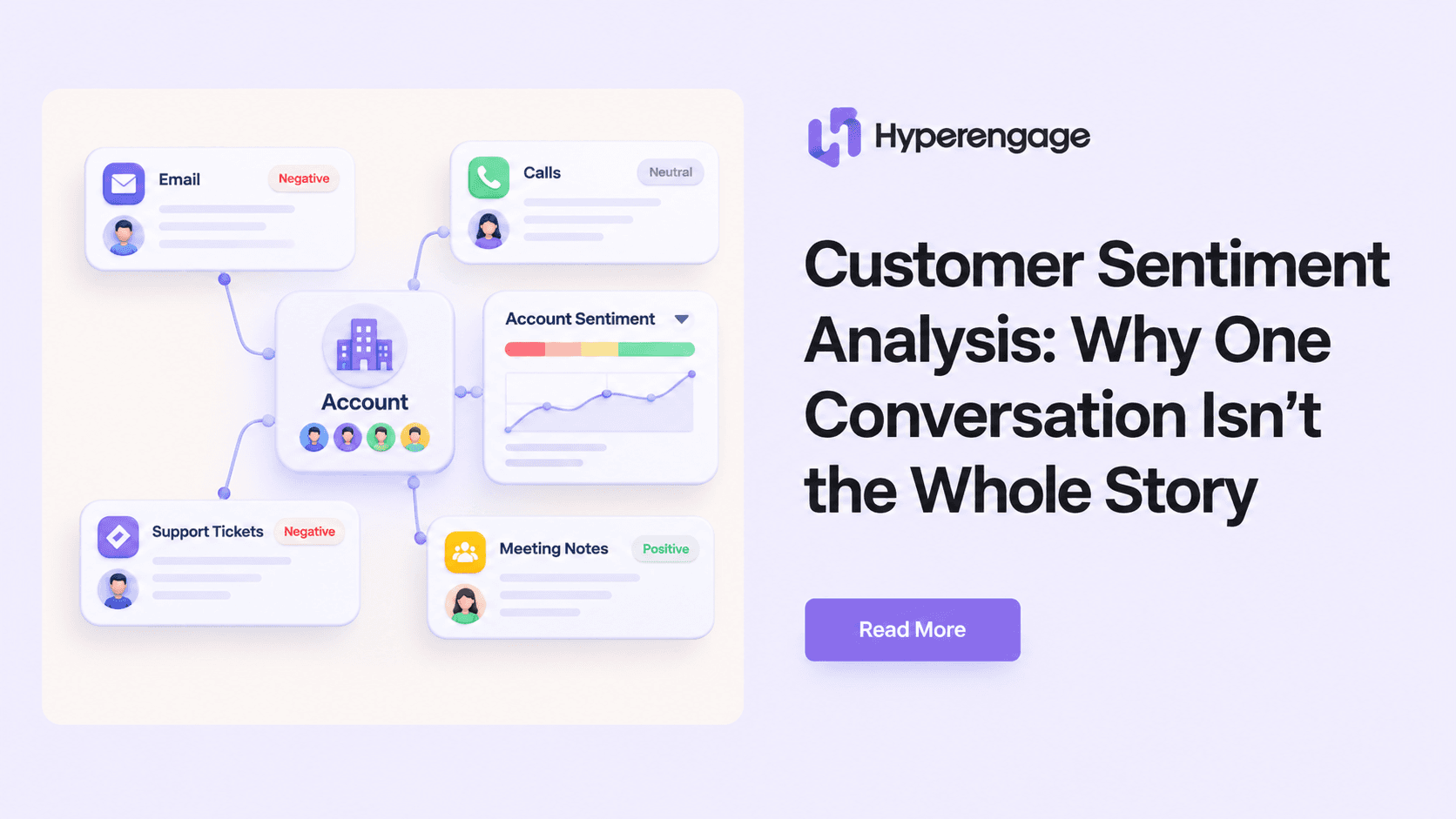
Here’s what gets missed. Most CS teams aren’t short on customer feedback. They’re drowning in it, just not in one place. A support ticket says exactly what broke, in the customer’s own words, days before anyone thinks to survey them about it. A sales call note from the renewal conversation six months ago describes what the buyer actually cared about, sitting untouched in a CRM field nobody revisits. A Slack channel with the customer holds a running record of frustration or delight that never makes it into any report. Usage data shows a feature nobody’s touched in three weeks, which is a stronger opinion than most people will ever volunteer out loud.
None of that is new information. It’s the same feedback that would show up in a survey, except it already exists, and it’s already timestamped to a specific account. The gap was never collection. It’s that nobody reads across all of it for the same account before it’s too late to act on what it’s saying. Getting that right starts with treating support conversations as a live input, not a ticket queue to close, which is exactly the shift behind closing the loop between product and customer-facing teams.
A Survey Catches a Mood. It Can’t Catch a Trend
A quarterly NPS cycle is a snapshot. It tells you how an account felt on the Tuesday the email landed in their inbox, assuming they opened it at all. It says nothing about the six weeks before that snapshot, when usage was quietly declining, or the two weeks after, when a key stakeholder left the company. By the time the next survey goes out, the story has already moved on.
Lincoln Murphy, former VP of Customer Experience at ListKit, made a version of this point on the Across the Funnel Podcast when he broke down what actually predicts churn. Rather than treating the churn number itself as the thing to manage, he argued for watching the signals underneath it.
“We have pretty clear understanding of why our customers churn and we look for the signals… churn isn’t the issue. Churn is a symptom of another issue… we have a lot of signals that we can look at that tell us whether or not a customer is getting value.”
That’s the distinction a survey cadence can’t offer. A score tells you the outcome. Signals tell you why it’s happening, while there’s still time to do something about it. Most teams that build a customer health score around survey data alone end up measuring the symptom and missing the cause.
Usage Is a Vote Your Customers Cast Every Day
If you want to know whether a customer is actually satisfied, watching what they do tells you more than asking them to rate you. Sara Wyman, Founder and CEO at Stackpack, made this almost embarrassingly simple on the Across the Funnel Podcast when she explained how her team reads customer health.
“For us, honestly, it’s pretty clear. It really is like usage and engagement, right? And so there’s a few signals we have… The obvious one is if your team is logging in every day and doing procurement workflows… then again, that’s telling us that you’re getting value there.”
No survey required. A customer who logs in daily and works your product into their routine has already answered the satisfaction question, more honestly than a 9-out-of-10 rating ever could. The reverse is just as telling. A glowing NPS response from an account whose usage has quietly flattened isn’t a contradiction to investigate. It’s a warning that the product hasn’t actually been adopted the way the score suggests.
The Small Behavioral Shifts Nobody Bothers to Track
The signals worth watching aren’t always the obvious ones like login counts or feature clicks. Sometimes they’re quieter, structural changes in how a customer is actually using the relationship. Jon Finegold, CEO of Precog, described this on the Across the Funnel Podcast while talking through how his own team tracks customer risk.
“How many connections, how many different sources are they connected to, how much data is moving, is it changing, is it going up, is it going down. And those are good indicators of, hey, their data business is growing. Let’s engage and see if we can help them even more.”
He calls these his “plumbing metrics,” and the name fits. Nobody surveys a customer about how many integrations they’ve configured. But a customer quietly disconnecting a data source is telling you something a satisfaction score never will, and a customer adding new ones is showing you expansion appetite before they’d ever say it out loud in a QBR.
Turning Scattered Signals Into One Picture
Once you accept that the feedback already exists across support, usage, calls, and integrations, the real work isn’t collecting more of it. It’s synthesis. A support ticket read on its own is noise. A behavioral shift in usage read on its own is ambiguous. Read together, against the same account, in the same week, they stop being scattered notes and start being a reason to call someone before they have to ask for help.
This is the same reframe behind Hyperengage’s approach to account intelligence: signals pulled from wherever they already live and read together in real time, rather than a survey score reviewed once a quarter and treated as the whole truth. The technology to do this at the pace a CS team actually operates didn’t really exist a few years ago, which is part of why quarterly surveys became the default. That constraint isn’t really an excuse anymore, but a lot of programs still run like it is.
What Changes When You Stop Waiting for the Survey
None of this means scrap NPS or stop asking customers directly how they feel. Direct feedback still catches things behavior alone can’t explain, like why a customer feels a certain way, not just that they do. The shift is in what gets treated as the primary signal and what gets treated as a supplement.
Start by mapping where feedback about your accounts already lives today, before building anything new. Most teams find it’s scattered across four or five systems that never talk to each other. From there, the goal isn’t a bigger dashboard. It’s a trigger. A dashboard is something someone has to remember to check. A trigger fires when a specific combination of signals shows up on a specific account, the same week it happens, which is the only way any of this actually changes behavior instead of just producing another report nobody opens. That discipline matters most in the first weeks of a relationship, when the difference between a customer who sticks and one who quietly disengages often shows up in usage patterns long before anyone would think to send a survey.
Conclusion
Voice of the customer was never supposed to mean a survey calendar. It was supposed to mean actually hearing what customers are telling you, and most of what they’re telling you was never going to arrive in a comment box. It’s already sitting in a support queue, a usage graph, and a call transcript, waiting for someone to read all three at once. The teams that figure this out first won’t be running better surveys. They’ll have stopped needing one to know how their customers really feel.